Bending Spoons Buys Mailchimp, AI Shapes Cyber Week, and Shoppers Chase the Deal | Week of Nov 20, 2026

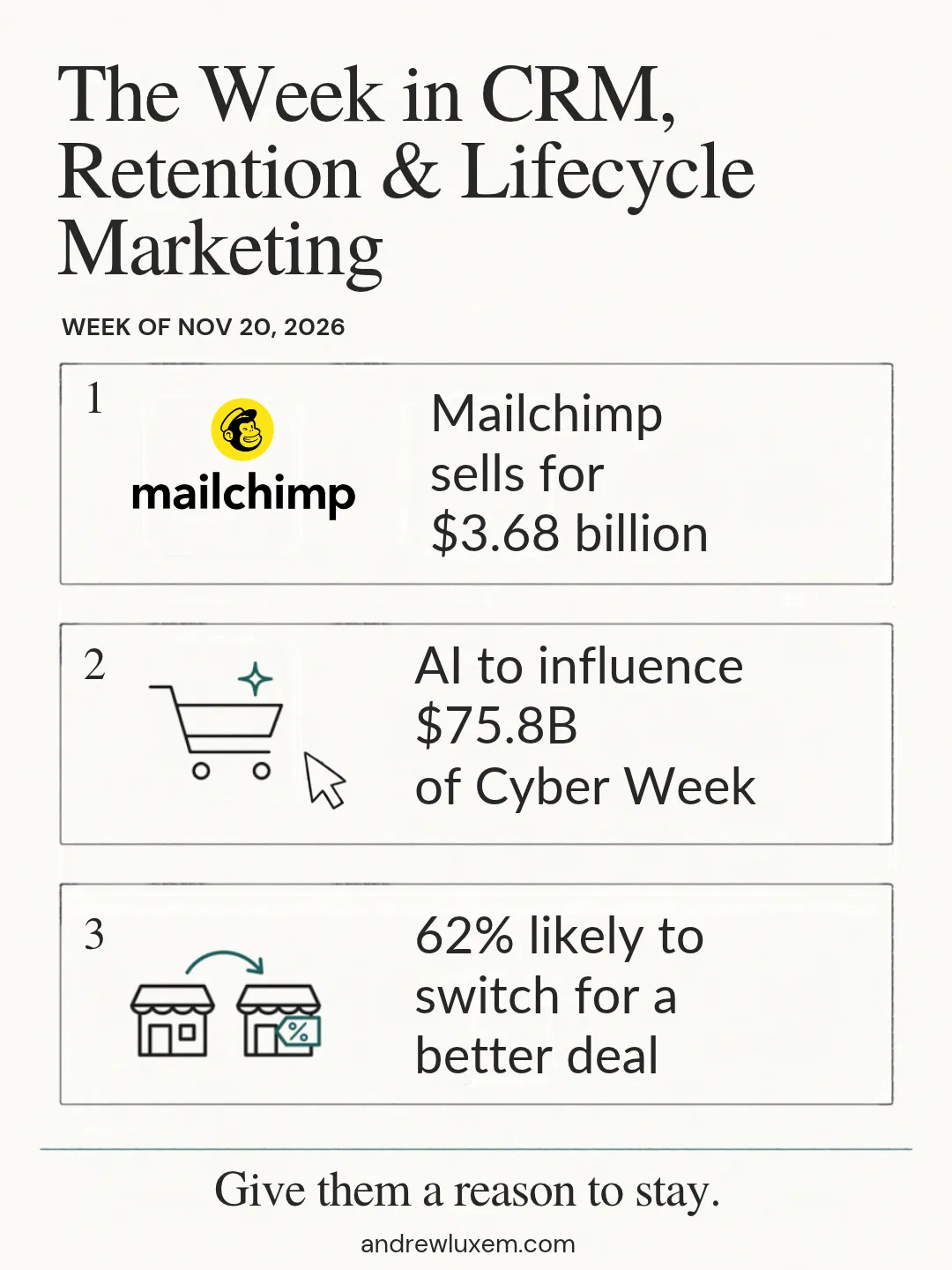
On November 19, Bending Spoons agreed to acquire Mailchimp from Intuit for an enterprise value of $3.68 billion. That same day, Salesforce forecast that AI and agents will influence $75.8 billion in online sales during Cyber Week. The day before, ICSC found that 62% of Thanksgiving weekend shoppers are likely to switch retailers if their usual retailer doesn’t offer an attractive deal.
That’s a lot to move the week before Black Friday. I’d spend this week on what you control: a list you can move, flows that fire for every order type, and a reason to return that a price comparison can’t beat.
Who owns the customer
1. Bending Spoons agrees to acquire Mailchimp for $3.68 billion
On November 19, Bending Spoons announced it had signed a definitive agreement to acquire Mailchimp from Intuit at an enterprise value of $3.68 billion. Intuit’s earnings release shows the deal is valued at $3.31 billion in cash and $368 million in Bending Spoons stock, with closing expected in early 2027, subject to regulatory approval. Intuit said the sale “sharpens Intuit’s focus” on its lead-to-cash strategy and reported Mailchimp revenue down 1% to $313 million for the quarter.
Bending Spoons CEO Luca Ferrari said the company will “invest substantially in the business,” and neither release announces changes to Mailchimp’s plans, prices, or staff. At the time, Intuit paid about $12 billion for Mailchimp. Spam Resource notes that Bending Spoons announced earlier this year plans to acquire AOL, which would place a consumer mailbox provider and a major sending platform under one owner. What that means for deliverability remains speculative.
Nothing changes for senders before close, but a new owner gets a fresh say on account tiers, pricing, and infrastructure. If you run on Mailchimp, I’d confirm now that lists, consent records, and engagement history export cleanly, and map which flows you’d have to rebuild. Then, if pricing changes in 2027, you’ll have time to decide what to do.
2. Salesforce expects AI to influence $75.8 billion of Cyber Week sales
On November 19, Salesforce said it expects Cyber Week, Tuesday, November 24 through Monday, November 30, to drive $357 billion in global online sales, with $84 billion in the US, up 6% year over year. It expects AI and agents to influence $75.8 billion of the global figure, up 13% from 2025. Its Shopping Index shows AI-driven traffic to retailer sites up 104% year over year, and Salesforce says 20% of holiday shopping traffic will be nonhuman.
These projections are based on Salesforce’s Shopping Index, which includes more than 1.5 billion shoppers, blended with third-party data and market assumptions. Salesforce owns Marketing Cloud and is buying Braze, so it has a stake in the agent story. Adobe’s September forecast shows AI-driven traffic to US retail sites up 130%, measured by shopper click-throughs, so the two figures measure different things. The same Salesforce release says 73% of shoppers still aren’t ready to hand over their card details to a personal agent.
Part of this year’s peak traffic will come from an assistant, and some of it won’t be human. Salesforce reports that shoppers arriving via AI referrals are twice as likely to convert, so I’d separate those sessions in reporting before Tuesday. Then verify that browse and cart abandonment flows fire only for identified shoppers, so bot sessions don’t trigger sends.
3. 62% of Thanksgiving weekend shoppers are likely to switch to a better deal
ICSC released its Thanksgiving Weekend Intentions Survey on November 18, based on an online survey of 1,007 US adults conducted from November 9 to 11. 88% plan to spend from Thanksgiving Day through Cyber Monday, and ICSC projects $124 billion in spending. 62% say they’re likely to switch to another retailer or brand if their preferred one doesn’t offer an attractive deal, and 40% describe themselves as value-seekers who shop wherever prices are lowest, up from 34% in 2025.
ICSC, a trade group for shopping centers, ran its own survey. The release doesn’t explain how it arrived at $124 billion. The AI numbers tie back to Salesforce: 65% plan to use AI tools to help them shop, most often to compare prices (31%), and 9% plan to let AI complete the purchase. A price-comparison assistant makes switching easier.
For most of these shoppers, loyalty over the long weekend depends on the offer. I’d give known customers something a price comparison can’t match, such as early access or bonus points. Hold out a slice of the list and check in December whether it moved to repeat purchase.
Before the first send
4. Klaviyo ties higher clicks to recent behavior across 274 billion sends
Klaviyo published a study on November 17 covering about 274 billion emails sent by about 92,000 Klaviyo brands from September 2025 to August 2026. Flow emails that referenced what a shopper had just done earned 45% higher click rates, and campaigns that did the same earned 33% higher. Each brand’s personalized emails were compared with its own non-personalized emails, adjusted for send month, audience size, and flow type.
These are Klaviyo’s observed averages across its own customers, with revenue measured as Klaviyo Attributed Value, so it isn’t a controlled test. Personalized flow emails earned 23% higher click rates overall, about half the lift of those that referenced recent behavior.
The biggest lift comes from data most programs already collect. Before adding new profile fields, I’d audit which flows still ignore the customer’s last action, starting with browse abandonment and post-purchase.
5. Klaviyo builds approval into Composer for peak week
Klaviyo’s November 17 product post lists six updates ahead of Black Friday. Composer builds campaigns, flows and tests from a brief, connects to more than 10 apps, and requires approval before anything sends. Shareable preview links let up to 10 reviewers see an email without a Klaviyo login. Customer Agent now keeps cross-channel memory of shoppers, and a new CX Score uses AI to rate each conversation.
Klaviyo also says its new sending infrastructure “can send 100 million messages in 20 minutes.” That’s Klaviyo’s own claim. Peak-week delays usually stem from approval processes.
Login-free previews take one step out of the review loop. I’d name who can approve an agent-drafted flow before Monday and send them the preview links now.
6. Courts narrow Do Not Call claims over texts as FCC opt-out rules take effect November 25
Mintz’s November 16 roundup describes recent decisions that narrow the TCPA’s private right of action under Section 227(c)(5). In Bronstin v. Happy Cabbage Analytics (M.D. Pa., October 29), the court held that unwanted texts do not give rise to a Section 227(c)(5) cause of action for violations of the national or internal Do Not Call rules. In Lowrey v. Twilio (W.D. Va., October 1), the court held that cell lines are not “residential.”
These are district court rulings, not appellate decisions, and Mintz notes that state mini-TCPA laws may still apply. Meanwhile, the FCC’s revised consent-revocation rules, which I covered two issues ago, take effect November 25. Marketing texts must honor any of the listed opt-out keywords, and one revocation of telemarketing covers all future marketing texts from that sender.
Narrower federal Do Not Call exposure is no reason to relax two days before Black Friday. I’d text every opt-out keyword to every sending number this week and confirm each one suppresses the contact across all marketing texts.
7. Black Friday phishing is up 103% before the sales start
KnowBe4’s Threat Lab reported on November 18 that, according to its PhishER Plus data, Black Friday and holiday-sale emails were 103% higher in October than in September and 165% higher in the first week of November. Black Friday scam detections in KnowBe4 Defend rose 260% in the first week of November compared with the previous week. The common lure is an “early access” email using a spoofed brand name from an unrelated domain, directing recipients to a fake store that collects personal and payment details.
KnowBe4 sells security training and doesn’t provide sample sizes. About 94% of the scam emails it reviewed featured luxury goods, so the mix will vary by category.
Your real early-access email is competing with fakes that look like it. I’d make sure DMARC is set to enforcement and put early-access offers in the app or on the account page as well, so customers can confirm an offer without clicking the email.
Earning the second order
8. ChatGPT Wallet puts agents at checkout
OpenAI launched ChatGPT Wallet on November 13 in partnership with American Express, Mastercard, and Visa. Users approve each transaction using biometric verification, and a payment token replaces card details. Fintech Futures reports that OpenAI won’t charge transaction fees for now. The rollout is gradual, starting with ChatGPT Pro users in the US who have US-issued cards.
Visa’s Agentic Commerce Benchmark, released on November 5, shows why the approval step matters. Across 22 AI models and 15 shopping challenges, the models passed 57.2% of test runs and failed 42.8%, and Visa says 54% of failed runs still ended in a purchase.
When an agent places an order, the shopper may never see your welcome flow, and an incorrect purchase becomes a return handled by your service team. I’d confirm that order confirmation and post-purchase flows fire for agent-placed orders and that those customers can be identified in the profile.
9. Microsoft and Salesforce launch Copilotforce
Microsoft and Salesforce announced Copilotforce at Microsoft Ignite on November 17, bringing Salesforce customer context and actions into Microsoft Copilot. Salesforce in Copilot is in public preview with 38+ prebuilt sales skills, and writebacks to the CRM require explicit user confirmation and respect existing validation rules. Data federation from Microsoft OneLake into Salesforce Data 360 is generally available.
The release names Sales Cloud and Data 360 but doesn’t mention Marketing Cloud. Its only marketing example is a marketer building a segment from spending behavior federated from Fabric into Data 360.
The CRM is becoming a data source that agents read wherever people work. For lifecycle, federation is the useful piece. I’d check whether the spend data you segment on can be queried where it lives, rather than copied into another table that drifts.
10. MarTech360 reports just 6% of digital tests target retention
MarTech360 reported on November 16 that Wingify’s State of Experimentation 2026 report found that 45% of feature experiments focus on conversion rate optimization, while just 6% target retention and engagement. The article says the feature findings come from testing activity across travel, retail, finance and media, separate from a survey of 108 organizations.
I couldn’t confirm either figure. Wingify’s benchmark pages are gated, its public benchmark report doesn’t include them, and the article provides no test count or time period. Treat them as MarTech360’s numbers until Wingify publishes them.
If your test calendar looks like this, you’re judging repeat purchase by attribution instead of experiment. I’d put one holdout on each core lifecycle flow and measure it on repeat purchase, not last-click revenue.
Before your Black Friday sends go out, run four checks. If you’re on Mailchimp, export a list with its consent records and confirm it’s complete. Split AI-referral sessions out of your reporting and confirm abandonment flows skip unidentified traffic. Text every opt-out keyword to every sending number before November 25. And put one holdout on a core lifecycle flow, so in December you can see what the long weekend did to repeat purchase.
Give them a reason to stay.
Sources
1. Bending Spoons, agreement to acquire Mailchimp (Nov 19, 2026); Intuit, first quarter results (Nov 19, 2026); Spam Resource, Bending Spoons to acquire Mailchimp (Nov 2026)
2. Salesforce, Cyber Week 2026 forecast (Nov 19, 2026); Adobe, 2026 US holiday shopping forecast (Sept 28, 2026)
3. ICSC, Thanksgiving Weekend Intentions Survey (Nov 18, 2026)
4. Klaviyo, email personalization study (Nov 17, 2026)
5. Klaviyo, BFCM 2026 product updates (Nov 17, 2026)
6. Mintz, Section 227(c)(5) and the TCPA’s narrowing private right of action (Nov 16, 2026); Mintz, Telephone and Texting Compliance News (Nov 16, 2026); Steptoe, FCC’s new TCPA consent revocation rules
7. KnowBe4, Black Friday phishing surge (Nov 18, 2026)
8. Fintech Futures, OpenAI debuts ChatGPT Wallet (Nov 2026); Let’s Data Science, ChatGPT Wallet launch (Nov 13, 2026); Visa, Agentic Commerce Benchmark, via Business Wire (Nov 5, 2026)
9. Microsoft and Salesforce, Copilotforce announcement (Nov 17, 2026)
10. MarTech360, Wingify State of Experimentation coverage (Nov 16, 2026)