Alexa Handles Subscriptions, ChatGPT Changes Ads, and SMS Rules Get a November Deadline | Week of Oct 30, 2026

A customer tells Alexa to pause a subscription. Next week, your replenishment email tells them it’s time to order again.
With November almost here, I’d fix that before adding another holiday send.
More decisions move into the tools
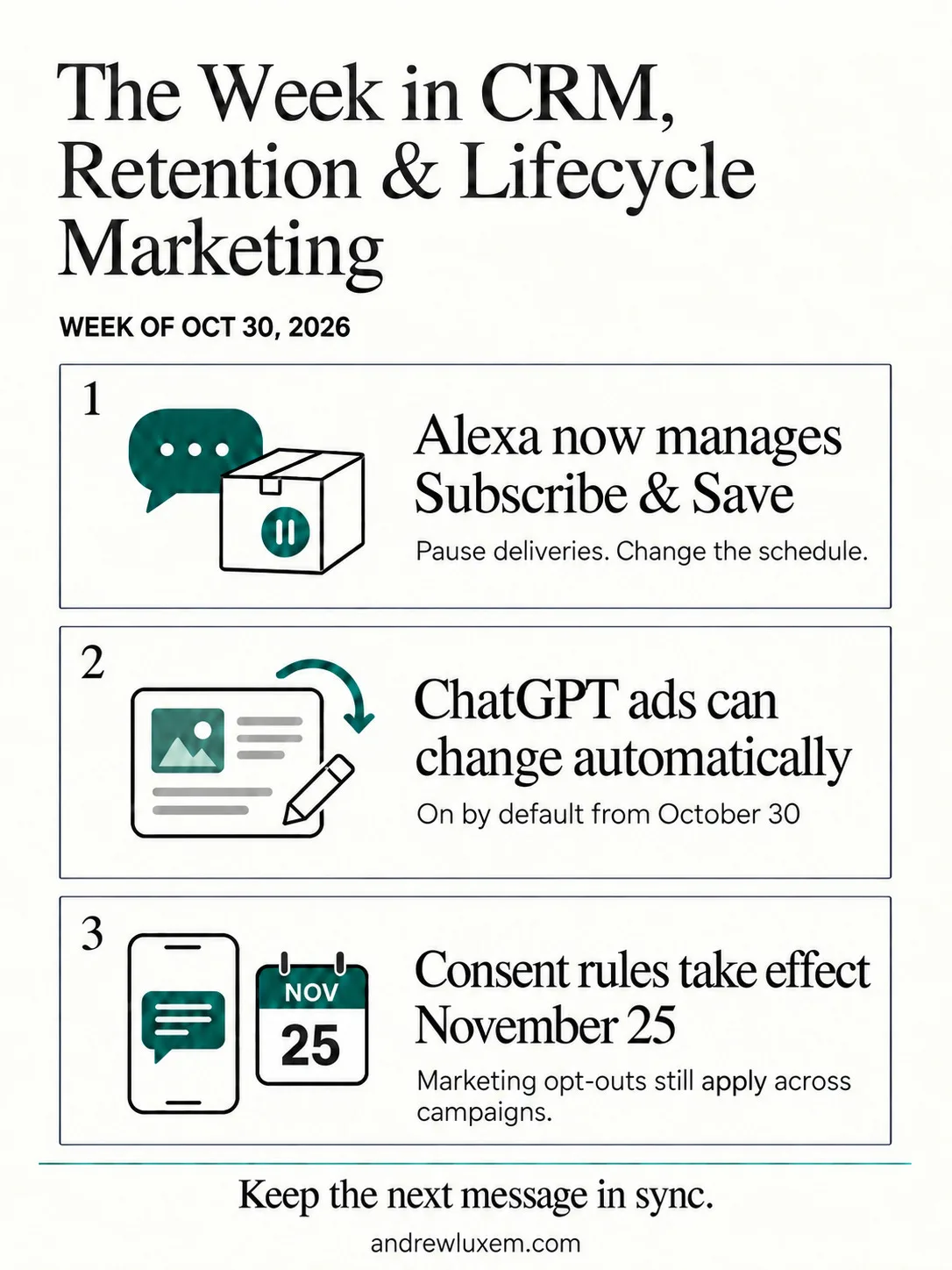
Alexa makes subscription changes easier Amazon’s Alexa can now handle more than 100 new shopping tasks by voice for everyone in the US. You can say “Alexa, skip my next coffee delivery,” change how often it comes, check when a membership renews, or ask about a charge or a refund.
When someone pauses a subscription, they’re telling you something useful. They still want the product, just later or less often. A marketing system that only watches for gaps in orders sees six weeks without a purchase and decides the customer is drifting away. Then it sends a “We miss you, here’s 15% off” email to someone who’s fine and just set their own schedule.
So pause a subscription in your own program and follow it. Does the pause show up in the data, and how long does it take to reach the system that sends your emails and texts? If the subscription system has it right and marketing keeps sending the wrong messages anyway, whose job is it to fix?
Klaviyo adds WhatsApp to channel affinity
Klaviyo’s channel affinity guesses which channel each customer is most likely to respond to, like email for one person and texts for another. As of October 29, WhatsApp is one of the options. A customer only gets a WhatsApp score if you’ve sent enough WhatsApp messages for Klaviyo to learn from, the customer has agreed to hear from you there, and they can receive messages on it.
The score tells you where someone is most likely to respond, not that you should message them more. Still, it’s easy for a team to see “Jane responds best on WhatsApp” and start sending Jane more WhatsApp messages. More responses don’t automatically mean more sales, and WhatsApp messages usually cost money to send.
Before shifting people to WhatsApp, do two checks. First, make sure your suppression rules carry over: anyone who opted out, or shouldn’t be messaged, has to be blocked on WhatsApp too. Second, keep a small group off WhatsApp on purpose and compare the two groups on purchases and on opt-outs. If the WhatsApp group buys about the same as the group you held back, you’re paying to reach people who would have bought anyway, and the channel is getting credit for sales it didn’t create.
Save your Attentive attribution settings before November reporting Attentive updated its attribution guide on October 28. Over Black Friday and Cyber Monday, Attentive locks your attribution settings, so you can’t change them yourself. Sales keep getting counted the whole time, and you can edit again starting December 2. Attentive hasn’t said when the lock starts, so assume it could be soon.
Those settings are the rules Attentive uses to give a text message credit for a sale. One of them is the window: how long after someone gets or clicks a text a purchase still counts as “because of that text.” Make the window longer and more sales get credited to SMS. Make it shorter and fewer do.
Changing the rules also rewrites history. Attentive recalculates past conversions under the new settings, so last year’s numbers can shift after the fact. Say you compare this November to last November without noticing someone changed the window in between. You’d be comparing two different scorecards, and a definition change would show up as growth or decline. Export your comparison reports now and write down which settings produced them, so you have a fixed record.
Even with the same rules on both sides, attribution tells you which sales came after a text, not which ones happened because of it. Many people who clicked a Black Friday text were going to buy anyway. To measure what the texts added, you need something like a holdout group that doesn’t get them.
Cordial puts customer data inside AI conversations Cordial launched a headless CDP on October 29 that lets marketers explore and visualize customer data through Claude, ChatGPT, Microsoft Copilot or custom agents. It builds on the AI infrastructure Cordial released in June. I recommend that you test it with a lapsed-customer query you’re already familiar with, and check the definition and count before trusting it with a new audience.
ChatGPT ads can change what happens before the welcome email If you run ads in ChatGPT, OpenAI now lets its own system tweak them for you, and starting October 30 that’s switched on unless you’d already turned it off. It can rewrite your headline or description, translate the ad into another language, and send people to a different page on your site than the one you picked. Nobody signs off on each version first.
The trouble shows up after the click. Say your ad promised 20% off and linked to that offer page. The system rewrites the ad and sends someone to your homepage instead. They sign up, and your welcome email says “here’s the 20% off you came for,” about an offer they never saw.
So find out which versions of the ad people are seeing and where those clicks land, then make sure the welcome flow still makes sense for each one. Searching ChatGPT yourself may not show you what a given customer saw, since the system can vary it, so check what the campaign’s reporting shows. If you’d rather keep control, check whether the feature is on for your campaigns and turn it off.
Permission and timing need a check before the holidays
Be prepared for the new FCC consent rules from November 25 Companies send two kinds of texts. Some are helpful, like “your package shipped.” Others are selling something, like “20% off this weekend.”
Starting November 25, if you reply STOP to a helpful text, the company can treat that as “stop sending me this kind of message” and leave the rest alone. If you reply STOP to a selling text, the company has to stop all its marketing calls and texts to you, including campaigns you never replied to.
A company can also set up its own official way to opt out, like a specific link or reply keyword. That only counts if the company explains it clearly and meets the FCC’s conditions. Even then, it still has to honor the obvious words people type, like STOP or UNSUBSCRIBE.
Your compliance team needs to see this before anything changes, because someone has to decide which messages count as helpful and which count as selling. Marketing has a reason to call things helpful, since fewer people drop off the list that way. If a promo gets labeled as a service message, an opt-out can be handled the wrong way, and that’s the kind of mistake lawsuits are built on. I’m not a lawyer, so check with your legal counsel on how this applies to your program.
Put RCS fallback on the holiday QA list RCS is the upgraded kind of text message, the one that can show images, buttons and branding. Not every phone can receive it, so businesses usually set up a fallback: if the RCS message doesn’t get through, a plain SMS goes out instead.
A business can also put an expiration on an RCS message, meaning “if this isn’t delivered in X seconds, give up.” Google’s October 29 update says that expiration can’t be shorter than six seconds.
When an RCS message expires, Google pulls it back and tells the business through a notification called the revocation webhook. Google’s guidance is to wait for that notification before sending the SMS, then wait a few seconds more, because a “delivered” receipt for the original message can show up late.
If your system runs its own stopwatch instead and sends the SMS the moment time runs out, the RCS message can still land a second later, and the customer gets the same message twice. That’s annoying on a normal day, and at Black Friday volume it’s more likely to happen and harder to catch. Before November, test what happens when delivery receipts arrive late, and make sure your system waits for Google’s notification instead of its own clock.
The journey continues after the order
That 46% AI return rate isn’t 46% of shoppers Blue Yonder’s October 27 survey found that 46% of US shoppers who bought after an AI recommendation returned one in the past year.
Picture 100 shoppers. About 24 of them have bought something because an AI tool recommended it, and roughly 11 of those 24 returned one of those purchases in the past year. That’s where the 46% comes from: 11 out of 24, not 46 out of 100. Keeping the denominator attached just means saying which group a percentage describes. Across all 100 shoppers, it’s closer to 1 in 9.
The number also doesn’t tell you the AI recommendation caused the returns. People return things all the time, and the 46% on its own doesn’t compare these shoppers with people who found products some other way. Their return rate could be completely normal.
So for customers who came in through an AI recommendation, look past the first purchase. Check why they sent things back and how much revenue you kept after returns. A returned sale stops being revenue, so do that check before you call AI recommendations a successful new source of customers.
Make the value usable
- **Help people shop within a smaller budget **An Ipsos poll for Thrivent, published October 28, found 68% of Americans plan to cut holiday spending in at least one area, versus 69% last year. Among people cutting gift spending, 66% plan to buy fewer gifts, up from 56%. I’d try a gift guide built around total budget, delivery included, before sending another countdown.
- Citi’s new benefits need onboarding Citi and American Airlines announced October 27 that changes for existing cardmembers start January 24, 2027. Platinum Select adds Walmart+, Business adds a 2X category the member picks, and both annual fees go from $99 to $150. The retention job is getting members to activate and use those benefits before the higher fee gives them a reason to reconsider.
Before November gets busy, pick one of your journeys and act like a customer who buys something and then changes their mind: return it, cancel, pause, or unsubscribe. Then watch for the first message that doesn’t fit, like “How are you liking your new blender?” after you’ve sent it back, or a reorder reminder after you paused.
When you find it, assign an owner to that fix, because problems that nobody owns tend to stay broken once the holiday rush starts. That’s the practical test behind Customer Behavior Should Guide the Decision.
Sources
- Amazon, new Alexa for Shopping capabilities (Oct 29, 2026)
- Klaviyo, What’s New (Oct 29, 2026); Klaviyo Help Center, channel affinity
- Attentive Help Center, attribution settings (updated Oct 28, 2026)
- Cordial, headless CDP launch, via PR Newswire (Oct 29, 2026)
- Federal Register, FCC final rule on consent revocation (Oct 26, 2026)
- Google, RCS for Business release notes (Oct 29, 2026)
- Blue Yonder returns survey, via Business Wire (Oct 27, 2026)
- Ipsos and Thrivent, holiday survey (Oct 28, 2026); topline results
- Citi and American Airlines, AAdvantage card changes (Oct 27, 2026)