AI Service Scores 86% vs. 51%, Iterable Hosts Its MCP Server, and Attentive's New CEO Ships MCP | Week of Nov 13, 2026

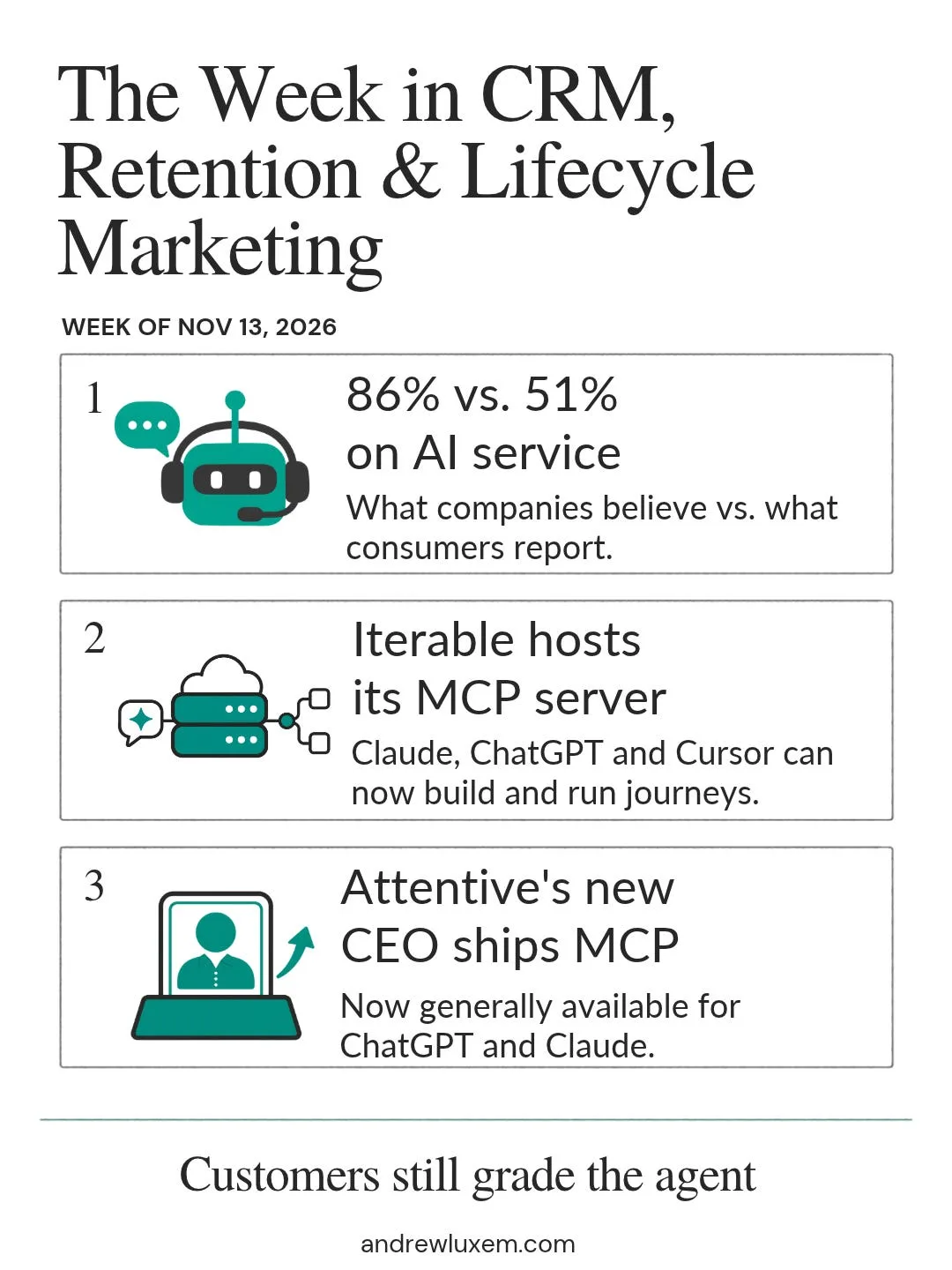
Twilio asked companies and consumers how AI customer service is performing. 86% of companies believe their customers are satisfied, while only 51% of consumers say AI interactions are satisfactory. In the same week, Iterable and Attentive both opened platforms that send your journeys to ChatGPT and Claude.
Vendors are giving agents more control faster than customers are warming to them. With two weeks to Black Friday, I’d check what customers report before trusting the dashboard.
Agents got the keys
1. Companies rate AI service at 86%; consumers at 51%
Twilio released its 2026 Customer Insights report on November 9; 86% of companies believe customers are satisfied with their AI-powered customer service. However, only 51% of consumers say AI-powered interactions are satisfactory. 78% of consumers have tried to bypass an AI agent to reach a person, and 63% want a quick way to escalate to a live person at any time.
These are two distinct groups answering two different questions. The 86% comes from 660 business leaders at the Director level or above at companies with 500 or more employees. The 51% comes from 7,652 consumers in 18 markets, surveyed from April 9 to May 1, rating AI interactions with businesses in general rather than a single company’s service. So it isn’t the same customers judging the same agent, but it’s still the widest gap on this issue.
I’d act on the transparency numbers first. 76% of consumers say an AI agent should identify itself at the start of a conversation, while only 32% of businesses say they actively prioritize AI transparency. Before peak, check that your agent says what it is, that it hands off to a person without a fight, and that a bad service contact changes what lifecycle sends next. A customer who just fought a chatbot shouldn’t get a review request the next morning.
2. Iterable hosts its MCP server for Claude, ChatGPT, and Cursor
Iterable’s Winter launch on November 12 added a hosted MCP server that brings Iterable into Claude, ChatGPT, and Cursor. Requests run through Nova Agent, Iterable’s AI assistant, which can handle multi-step tasks such as building a journey and proofing its email. Each person signs in with their own Iterable login, and the agent is limited to that person’s existing permissions.
This isn’t Iterable’s first MCP server. A self-hosted version previously ran on an individual’s machine using a personal API key, and Iterable says it remains available and free. Now Iterable runs the server itself, so an entire team can use it without anyone managing their own setup. The same launch also expanded the Integrations Hub to include Chargebee, Recurly, Punchh and HubSpot, among others, bringing billing, subscription and loyalty events closer to journey triggers.
An agent that inherits your permissions can do anything you can. If half the team has admin rights because it was easier at setup, the agent has them too. Before you connect it, I’d review roles and decide who approves an agent-built journey and what that approval checks beyond the copy.
3. Attentive’s new CEO ships MCP
Attentive named co-founder Eric Miao its new CEO, and Attentive made its MCP server generally available for ChatGPT and Claude. Marketers can use prompts to retrieve Attentive data, build segments, and create or edit campaigns and journeys. They control whether the assistant can make changes and review customer-facing work before it goes live.
Miao said, “A lot of what’s called agentic AI in marketing today is really just automation with a new name.” The two customers Attentive named use MCP for reporting and analysis. ReserveBar automates its weekly performance reporting, and MintRX analyzes past campaigns and identifies problems in existing journeys. Neither has an agent that builds journeys yet.
I’d hold every vendor shipping agent to Miao’s line. Can the system decide when to hold a message back, or only what to send next? Automation already handles the latter.
The promise after the click
4. Unclear delivery dates cost retailers carts, says 54% of shoppers
Locus surveyed 1,000 US consumers for its Holiday Delivery Confidence Index, released on November 10. 54% said they abandoned an online cart in the past 12 months because they weren’t sure the order would arrive when needed. 80% said a specific promised delivery date would make them more likely to complete a holiday purchase. 61% mostly or completely trust retailers’ order-by promises, but only 18% fully trust them.
Locus sells delivery software, and the release doesn’t name a survey vendor or fielding dates, so treat it as directional. It still matches what I’ve seen: an order-by date is a promise the customer remembers. I’d include a specific arrival date in the cart and the order confirmation, then send an update the moment it slips. 35% of shoppers expect to switch an order to pickup, and 34% expect to reschedule delivery without calling support, so link to both in the shipping email. That week's performance determines a lot of second orders.
5. Peter Thomas Roth’s RCS beat SMS by 40% in conversion
Peter Thomas Roth ran its first RCS campaigns with Listrak, offering early access to sales, gift-with-purchase offers, and loyalty rewards. In 50/50 tests against SMS, RCS beat SMS on conversion rate by an average of 40% and generated 29% more revenue per send. About 85% of the brand’s subscribed mobile audience could receive RCS; the rest received SMS. Click-through went from a 14% decline on the first RCS send to a 3% lift on later sends.
This is one brand, in a release co-issued by the RCS-selling platform, with no sample size or test length provided. Head-to-head tests like this are still rare, though. The click-through numbers suggest customers needed a few sends to get used to a branded, verified sender, so if you test RCS before Cyber Week, give it more than one send before you judge it.
6. 22% of Americans canceled a subscription after a price increase
Bango surveyed 2,500 US adults with 3Gem from September 24 to 30 and released the results on November 12. 22% canceled a subscription after a price increase in the past 12 months. 40% wanted to keep a subscription but had to cancel because they couldn’t pause it or downgrade to a free option, rising to 50% among Gen Z. 61% say they would be more likely to keep subscriptions offered at a lower price in a better-value bundle.
More than half (52%) still believe their subscriptions are worth the money. Most of them didn’t want to leave; the cancel flow just gave them one way out. If you run a subscription, open your own cancel flow this week. If pause and downgrade aren’t on the first screen, fix that before you announce your next price change.
Proving it pays
7. Klaviyo segments customers by how they respond to discounts
Klaviyo’s release log added Discount Affinity on November 12, labeled Preview. It sorts profiles into Deal seekers, Mixed buyers, and Full-price buyers based on each profile’s discount history, and you can target campaigns and flows to each group. Klaviyo pitches it as a way to protect margin by saving offers for Deal seekers.
Past coupon use shows who took a discount, but it doesn’t prove they needed one. Some deal seekers would have bought at full price; you taught them to wait. Before locking in this split for Black Friday, send a full-price version to a segment of deal seekers and compare orders. The difference is what the discount actually earned.
Klaviyo also added version history to live flows on November 9. You can see who changed what, including changes made by Composer, and restore an earlier version. With agents editing journeys, this serves as your audit trail.
8. Loyalty budgets are rising, yet only 32% of consumers are impressed
On November 9, Arrivia released findings from two separate surveys. 86% of 250 US business decision-makers expect loyalty budgets to grow over the next two years. Among 2,007 US consumers, 90% expect to remain loyal to their preferred brand, but only 32% say its rewards program consistently exceeds expectations. The company calls the comparison directional because it didn’t match consumers to the businesses surveyed.
The consumer answers point to where the money should go: 40% want more valuable everyday rewards, compared with 32% who want bigger rewards earned over time. Before you add a tier, I’d check how many members redeemed anything this year and whether those who redeemed bought again. If members like the program but don’t use it, it’s mostly a cost.
9. 61% of marketers face C-suite pressure to demonstrate AI gains
Validity surveyed more than 250 B2B and B2C marketers for its Winter 2026-2027 Marketer Survey, released on November 11. 61% report pressure from the C-suite to demonstrate measurable gains from AI. The release doesn’t provide survey dates or methodology.
Faster production and incremental revenue are distinct measures, and the CFO will ask about the latter. If you’re planning for 2027, include one AI-assisted program with a holdout group and the revenue it generated during the holdout period. Hours saved won’t justify a budget on their own.
10. Email gets its own Gartner Magic Quadrant
Gartner published its first Magic Quadrant for Email Marketing Platforms on October 29, 2026. Bloomreach announced on November 3 that it was named a Leader and ranked highest on completeness of vision. Braze announced its Leader placement on November 9 and said it ranked first in all three use cases in the companion Critical Capabilities report: promotional messaging at 4.34 out of 5, and triggered and post-purchase messaging at 4.38 each.
Those rankings are each vendor’s summary of Gartner’s report, and I could confirm only these two Leaders, not the full list. Having email in its own analyst category, separate from multichannel hubs, helps anyone defending an email budget. If you’re shortlisting, score vendors against your own use cases first, starting with triggered and post-purchase flows, since that’s where most retention revenue comes from.
Before your biggest Black Friday send, do three checks as a customer would. Start a chat with your service agent to see whether it identifies itself as AI and how quickly it transfers you to a person. Put an item in the cart and look for a real arrival date. If you sell subscriptions, try canceling or pausing one. If you’re connecting an agent to your ESP this month, decide who approves its work before the first prompt touches a live flow. And if your SMS program isn’t ready for the FCC opt-out rule from two issues ago, it takes effect on November 25.
Customers still grade the agent.
Sources
- Twilio, The AI Expectations Gap, via Business Wire (Nov 9, 2026)
- Iterable, Winter 2026 product launch (Nov 12, 2026)
- Locus, Holiday Delivery Confidence Index, via PR Newswire (Nov 10, 2026)
- Peter Thomas Roth and Listrak, RCS results, via PR Newswire (Nov 10, 2026)
- Klaviyo, What’s New (Nov 9–12, 2026)
- arrivia, loyalty investment research (Nov 9, 2026)
- Validity, Winter 2026-2027 Marketer Survey, via PR Newswire (Nov 11, 2026)