Shoppers Doubt Black Friday Prices, Klaviyo Adds A/B Testing, and Salesforce Agrees to Buy Cresta | Week of Nov 6, 2026

Your Black Friday email says it’s the lowest price of the year. But the customer saw the same price in October and is now less likely to open the next email.
With two weeks to go, I’d focus on proving the savings.
Belief comes before the click
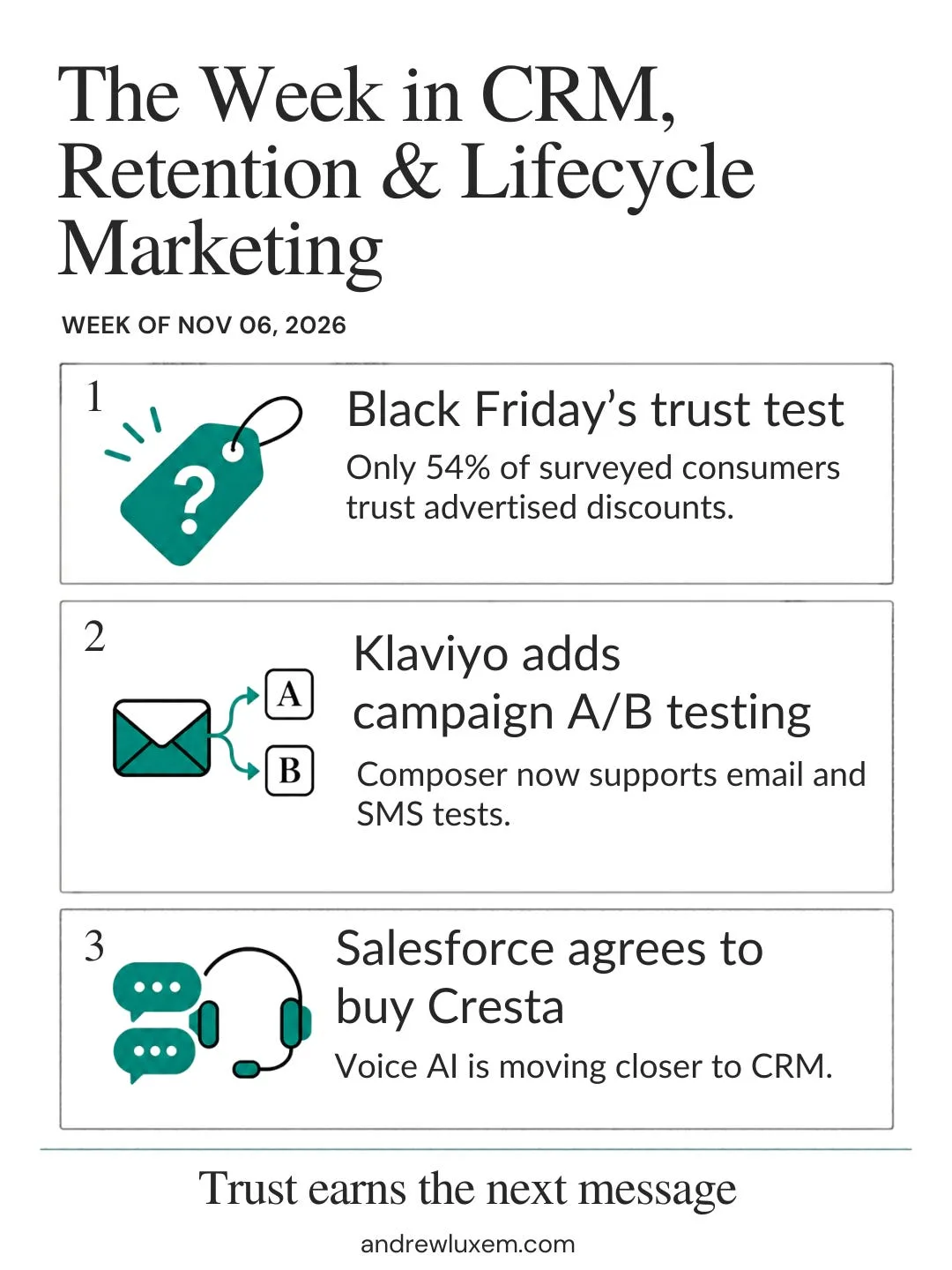
Shoppers don’t fully trust Black Friday prices BCG published a survey of 10,220 consumers in ten countries on November 4. Only 54% said that they trust Black Friday discounts to be lower than usual prices, and about one in five said they actively distrust them.
Among those people are those who plan to spend less or skip year-end sales entirely; 22% say it’s because discounts are always available. That’s 22% of that group, not of everyone surveyed. After a year of constant promotions, a Black Friday code is just another code.
Give people proof instead of a deeper discount. The cheapest option is the regular price shown right next to the sale price, with the return policy one click away. A countdown that restarts every time someone reloads the page is exactly the kind of urgency that taught shoppers not to believe the deadline.
Klaviyo adds campaign A/B testing Klaviyo’s release log for November 3 and 4 adds A/B testing to campaigns built in Composer, Klaviyo’s campaign builder, for both email and SMS. An A/B test sends two versions of a campaign to small parts of your list so you can see which version works better before you send it to everyone else.
Testing setup is much easier now. The part that still takes judgment is deciding what counts as winning. Do you judge a Black Friday test on email opens or clicks? The version with the loudest urgency will often come out ahead, even if it brings in fewer orders or more unsubscribes. Decide the measure before you build the test. I trust orders or revenue per recipient over opens or clicks, but you also want the signal, so decide what you prioritize.
Based on the BCG survey, here’s the test I suggest: one version with the regular price and the savings, and another with the countdown. Remember that email opens have been unreliable since Apple Mail Privacy Protection, so judge these tests by purchases.
More decisions move into the tools
Salesforce agrees to buy Cresta Salesforce agreed to buy Cresta on November 2. Cresta makes AI voice agents and software that analyzes customer service conversations. Salesforce plans to connect it to Service Cloud, its customer service product. The deal comes two weeks after Salesforce agreed to buy Braze.
A support call often tells you why a customer is leaving. “I’m canceling because my last two orders were late” says more than any engagement score. Usually that reason stays in the service system, and marketing keeps sending the usual emails. A customer calls to complain about a late delivery and, the next morning, gets an email asking them to review it. With this customer information, you can market smarter.
If customer service conversations start getting analyzed at scale, someone has to decide what marketing does with what they reveal. Both deals are agreed, not closed. Salesforce expects the Braze deal to close in its fiscal 2028, which starts February 1, 2027.
An outside agent can now build Klaviyo campaigns On November 3, Perplexity added e-commerce workflows to Computer, its AI agent, for Pro and Max subscribers. It can read a brand’s Shopify sales, build a landing page for the products it recommends, and run the same offer in Meta ads and a Klaviyo email. In Klaviyo, it also chooses who gets the email, using whatever customer data it can reach. Brands decide which steps wait for a person’s approval, from publishing the page to spending ad money.
Carrying one offer across every channel helps, but I’d focus most on the approval step. A reviewer can read the email copy and click through the page, but a preview doesn’t show the audience. Klaviyo still skips anyone who unsubscribed. Customers with an open return, or people already in a win-back flow, get the email unless someone excluded them.
Before you connect it, write down what the reviewer checks besides the creative, starting with which segment the email goes to and which exclusions are attached. I’d add whether Smart Sending is on.
Churn scores now feed straight into offers Cerillion sells billing and customer management software to telecom and other subscription businesses. Its 26.2 release on November 4 adds a churn model, and its scores can drive targeted campaigns and offers through Cerillion’s promotions engine. Retail teams have something similar already. Braze Predictive Churn gives each user a churn score from 0 to 100 that you can use to filter campaigns, Canvases, and segments. Klaviyo shows a churn risk prediction on each customer profile, based on how many orders someone has placed and how often.
A churn score tells you who might leave, but an offer won’t keep all of them. Some will leave anyway, and some were going to stay, and discounting either group costs margin for nothing. Hold back a group of flagged customers who get no offer, then compare how many stayed in each group. The difference between the two groups is what the offer earned. The take rate only shows who liked the discount.
Permission and deliverability need a check before peak
Your ESP won’t show you Gmail’s complaint rate On November 4, Audience Bridge wrote about pushing co-registration signups, where people join your list via a checkbox on someone else’s site. Its Gmail spam complaint rate, meaning the share of recipients who click “report spam,” stayed above 0.30% for four days in a row and peaked at 0.49%. Google expects bulk senders to stay under 0.30%. After the publisher cut new co-registration volume in half, the next reading was 0.06%. The author notes that one day isn’t proof.
Many teams push list growth hardest in November, using pop-ups and partner signups. I’d expect complaints to come from people who don’t remember signing up. If your complaint rate climbs, more of your mail lands in spam. Your ESP’s complaint report won’t show Gmail complaints, so the first sign may be a weak Cyber Monday.
Check where this month’s new subscribers came from, then look at Google Postmaster Tools the same day. If one source is bringing in people who complain, slow it down before your biggest sends.
Session replay needs consent in France Session replay tools record what visitors do on your site, down to clicks and keystrokes, so teams can watch sessions later. On November 5, the CNIL, France’s data protection authority, said these trackers need consent before they run. It also recommended clear disclosure, masking sensitive fields, and limits on what gets recorded. The guidance applies in France, but other countries may request similar measures later. Replay tools capture the most personal information on checkout pages and forms, though. What does yours record?
The journey continues after the order
Wayfair grew orders 12%, but repeat share stayed flat Wayfair reported third-quarter results on November 4. Orders delivered rose 12.2% to 11.0 million, and active customers grew 4.7% to 22.2 million. Repeat customers placed 80.0% of orders, about the same as 80.1% a year earlier. Orders per active customer over the past 12 months rose to 1.90 from 1.87.
Orders grew faster than active customers, so customers bought a bit more often. Because repeat share stayed flat while orders grew 12%, first orders grew at about the same pace as repeat orders. Whether those new customers return for a second order will matter most in 2027.
Your own results deserve the same scrutiny. Total orders, active customers, repeat share, and order frequency each answer a different question, and strong totals can hide underlying issues.
Holiday growth may be mostly inflation Visa forecasts that US holiday retail spending will rise 4.5% this year, but only 1.1% in real terms. When reviewing the holiday season, look at units sold, margin, and repeat purchases alongside revenue, because a promotion can appear to have worked simply because prices went up. Note that these are forecasts published on November 5, not actual results.
Most small brands have no plan to keep holiday shoppers Constant Contact surveyed more than 1,800 small business owners and 2,600 consumers across five countries. Of the owners, 77.2% expect to meet their holiday revenue targets. More than 70% have no plans to add new customers to their email list or loyalty program, and only 39% plan to send follow-up emails in the new year. Meanwhile, 75% of consumers plan to try a new small business this season. I recommend building the January welcome-back email now, while there’s still time to test it. The sample includes small businesses in five countries, so don’t treat it as data on mid-size US retailers.
Before Black Friday, open your biggest scheduled promotion and review it as a customer who checked your prices last month. Is the first price real, and is the deadline real? If you can’t back up the first claim, have one person fix it before you send. If your SMS program isn’t ready for the FCC opt-out rule from last week’s issue, fix that now too, before it takes effect on November 25.
Trust earns the next message if you prove it now.
Sources
- BCG, consumer trust in Black Friday discounts (Nov 4, 2026)
- Klaviyo, What’s New (Nov 3–4, 2026)
- Salesforce, agreement to acquire Cresta (Nov 2, 2026); Salesforce, agreement to acquire Braze (Oct 20, 2026)
- Perplexity, Computer for e-commerce (Nov 3, 2026); Unite.AI coverage (Nov 3, 2026)
- CNIL, session replay recommendation (Nov 5, 2026)
- Wayfair Q3 2026 results, via PR Newswire (Nov 4, 2026)
- Visa, US holiday spending forecast (Nov 5, 2026)
- Constant Contact survey, via Retail Insider (Nov 3, 2026)