Salesforce to Buy Braze, Gmail Reads Primary, and AI Picks the Brand | Week of Oct 23, 2026

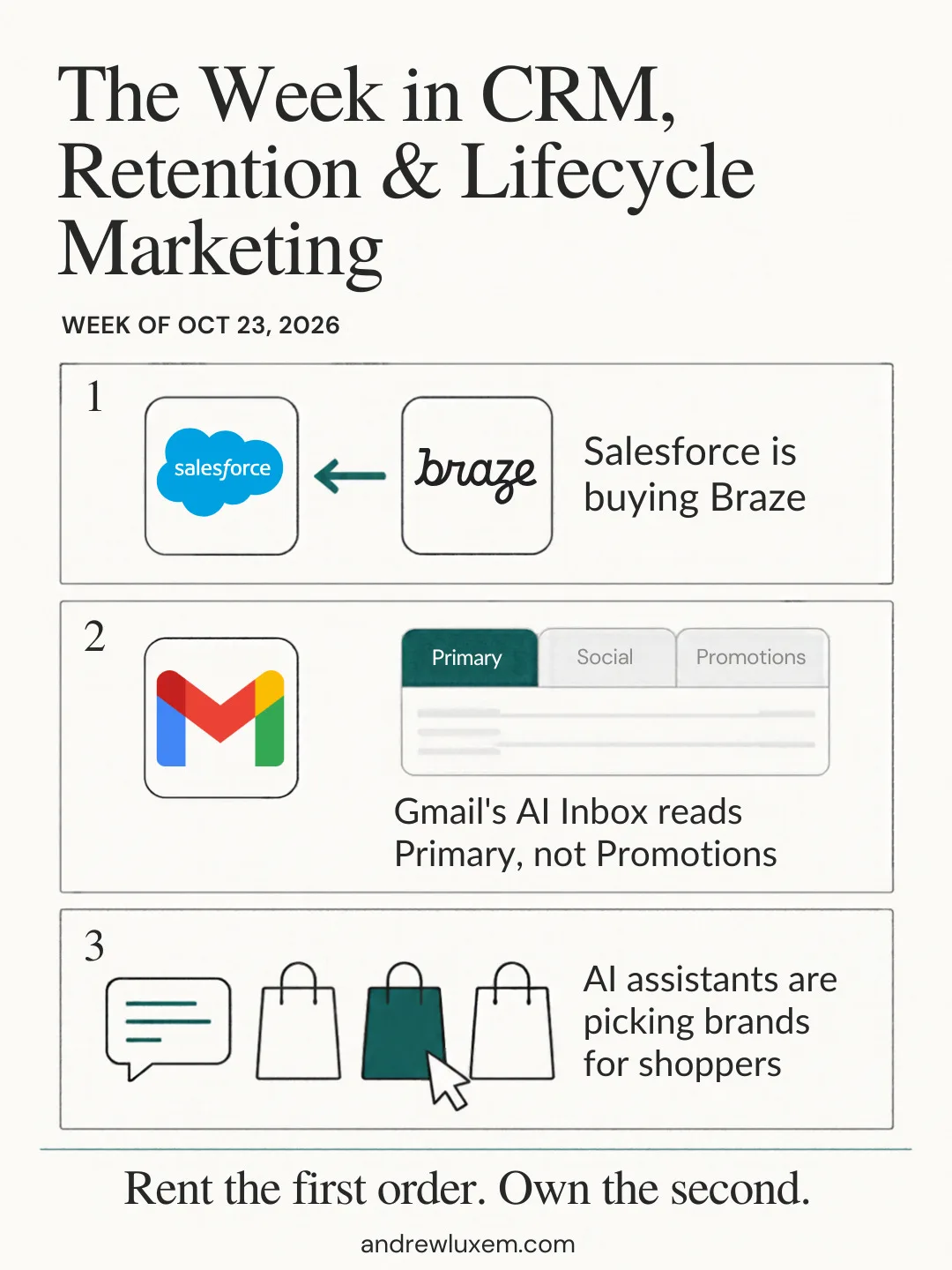
Salesforce agreed to buy Braze this week. Gmail started summarizing mail for people, AI assistants are picking brands for shoppers, and shoppers have stopped trusting the discount. All four push the first purchase further from your control. None of them changes what happens after the order, and that's the part a lifecycle program was built to handle.
Your stack is now a renewal decision
1. Salesforce agreed to buy Braze for about $5.66 billion in enterprise value, $47.50 a share in cash. The deal is expected to close in Salesforce’s fiscal 2028, which begins February 1, 2027. Braze has about 2,770 customers, and its note to them says “Your existing contract continues as is.” Integration waits until the deal closes.
So nothing breaks this quarter, and the decision shows up at your next renewal. Before then, a useful test is whether your team can explain what your journeys do without logging into the tool.
2. Futurum’s analysis names the gap Salesforce is paying to close. Marketing Cloud’s engagement product came from the 2013 ExactTarget deal and was built around batch email, while Braze runs on real-time events. Salesforce will now own two engagement engines, and customers will want to know which one gets the roadmap. Futurum also expects competitors to go after Braze’s largest accounts with migration help while the deal is pending, so if you have a renewal coming up, you have bargaining power. Klaviyo got pulled in too. Its shares rose nearly 8% in early trading on deal day, a few days after Goldman cut it to Neutral, and Jefferies named it a possible takeover target after the Braze news.
I’ve led platform migrations at more than one company, and the tool was never the hard part. The hard part was the journey logic nobody had written down. Document your triggers, suppressions and holdouts now, while nobody is making you.
The inbox is reading for your customers
3. Gmail’s AI Inbox is rolling out to paid Workspace users, and Google’s help page says it surfaces information from the Primary tab, not Social or Promotions. The same week, a Validity survey found 52% of marketers are adjusting subject lines or preview text for AI summaries, and only 29% say they’re well prepared.
Order confirmations, shipping updates and service replies usually land in Primary, and most promotional mail doesn’t. Your post-purchase email may now be the most visible email you send, so give it the care your campaigns get.
4. Validity’s peak-season data shows what volume costs. Gmail inbox placement dropped 9.7 percent across the first nine months of the year. During last year’s Black Friday week, complaints rose a modest 10 percent, and the bigger damage came 7 to 10 days later, right when holiday first-time buyers are deciding whether to buy again. A volume spike that drags placement down into December hits the second order.
5. Acoustic asked marketers and shoppers the same question. 46% of retail marketers said most of their Cyber Five messages were relevant. 22% of shoppers agreed, and 54% of shoppers unsubscribed, opted out or took some other action. In Acoustic’s own platform data, behavior-triggered emails drew a 5.50% click-through rate against 1.42% for scheduled sends. It’s vendor research, so weigh it that way, though I’d be surprised if the direction were wrong.
6. SMS consent lawsuits are settling for real money. Teleflora agreed to pay $6 million to settle a class covering about 23,844 phone numbers on the National Do Not Call Registry that got more than one promotional text in 12 months, and another SMS settlement followed the next day. Before peak, check where your consent records live and what happens when someone texts STOP.
AI is choosing the first brand
7. BCG’s holiday research says 56% of US consumers intend to shop with Gen AI this Black Friday. In 46% of purchases where AI plays a role, it introduces a brand the shopper wouldn’t otherwise have considered, and BCG says AI agents show much less brand loyalty and compare deals faster. A separate CommerceV3 analysis, reported by Chief Marketer, found 78% of about 25,000 ecommerce brands never appeared in AI recommendations in their own category. CommerceV3 sells AI visibility services, so read that one with care.
The traffic itself is still small. Marie Haynes looked at 12 months of GA4 data across 100 sites and found ChatGPT sent 0.62% as many sessions as Google organic, while Google still drove 96.5% of conversions, per Search Engine Roundtable.
Even so, an agent that brought a customer to you can send them somewhere else next time. The protection is a relationship the agent doesn’t own, like an email address, a phone number or an account, plus a reason for the customer to come back on their own.
Value has to be earned twice
8. Simon-Kucher found only 22% of shoppers think advertised discounts reflect true savings, down from 46% last year. HappyOrNot’s in-store feedback points the same way: 92% of consumers were happy overall, but only 83% were happy with price perception. If the discount no longer proves value, the second purchase gets won on product education, fit, service and how the first 30 days go.
9. Netflix raised prices in 2026, and its Q3 shareholder letter says churn improved year over year and came in better than forecast, with member response to the increases consistent with prior price changes. People who use a product a lot will absorb a price increase, and Netflix is a clean example of engagement depth paying off.
10. Metrigy’s survey with NiCE found 58% of consumers will leave a brand after two or fewer bad service experiences, down to 2.8 bad experiences from 3.2 in the first quarter. Returns count as service, and the bar is rising: TikTok Shop sellers can now use UPS Happy Returns and its 10,000 drop-off locations. Customers will compare your returns flow to that whether you planned for it or not, and your holiday buyers will be testing it in January.
Rent the first order, own the second
Most of this week’s news moved the first purchase toward systems you rent. What you control starts after the order: the confirmation, the shipping update, the first 30 days, the service reply, the return, and the triggered message that goes out because of something the customer did. You keep that system if you switch platforms. It lands in the tab AI inboxes read, and it’s what keeps customers through a price increase without an agent having to choose you a second time.
I wrote about that window in The First 30 Days After Purchase Matter More Than Your Re-Engagement Flow, and this week made the case stronger.
Sources
- Braze, Form 8-K, Exhibit 99.2 (Oct 20, 2026); Braze, DEFA14A filing (Oct 20, 2026)
- Futurum, analysis of the Salesforce-Braze deal (Oct 21, 2026); StocksToTrade on Goldman Sachs’ Klaviyo downgrade (Oct 20, 2026); Stocktwits on Jefferies and Klaviyo (Oct 21, 2026); IBTimes AU on Klaviyo’s share move (Oct 20, 2026)
- Google Workspace Updates blog, Gmail AI Inbox (Oct 15, 2026); Gmail Help Center, AI Inbox; Validity survey release (Oct 15, 2026); MediaPost on the Validity survey (Oct 19, 2026)
- Validity blog, peak-season deliverability (Oct 20, 2026)
- Acoustic, Cyber Five research release (Oct 22, 2026)
- TCPAWorld on the Teleflora settlement (Oct 19, 2026) and the follow-on SMS settlement (Oct 20, 2026)
- BCG, holiday consumer research (Oct 16, 2026); Chief Marketer on CommerceV3’s AI recommendation analysis (Oct 16, 2026); Search Engine Roundtable on Marie Haynes’ AI traffic study (Oct 22, 2026)
- Retail Dive on Simon-Kucher’s discount research (Oct 20, 2026); CX Dive on HappyOrNot’s in-store feedback (Oct 21, 2026)
- Netflix, Q3 2026 shareholder letter (Oct 20, 2026)
- CX Dive on Metrigy and NiCE’s consumer survey (Oct 19, 2026); Retail Dive on UPS Happy Returns for TikTok Shop (Oct 20, 2026)