Turn Meetings From Time Sinks Into Your Secret Weapon
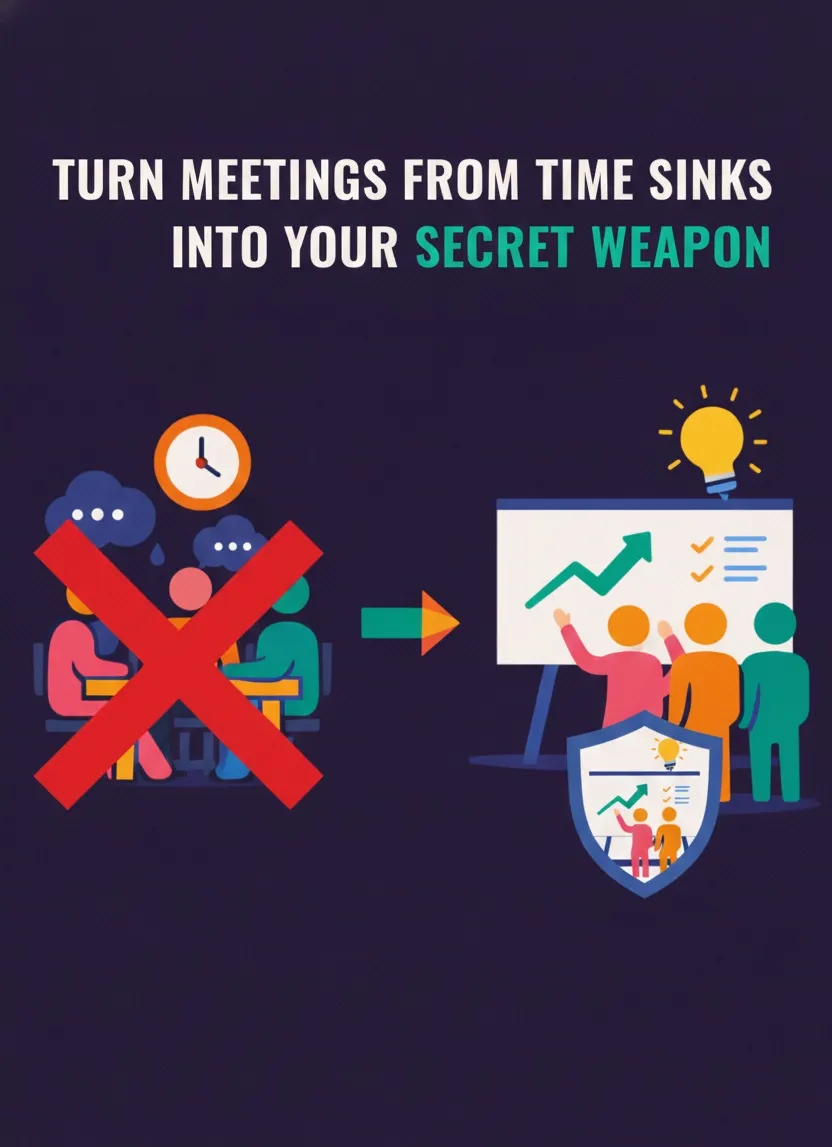
Turn Meetings From Time Sinks Into Your Secret Weapon
Let’s talk about something that frustrates almost everyone at work: meetings.
They interrupt deep work. They run long. They drift. And too often, they end with nothing to show for the time spent.
But here’s the twist: meetings don’t have to be a drag.
Done well, they’re one of the most powerful tools you have to align teams, make decisions, and move work forward.
This post is about flipping the script—turning meetings from a pain point into a competitive advantage.
“This Could Have Been an Email”
Be honest with yourself.
How many times have you sat in a meeting, staring at the clock, thinking:
“This could have been an email.”
You’ve probably even typed it to a coworker in a private chat. It’s basically the universal motto of the modern workplace.
Which raises a bigger question: why is this so common?
Meetings are supposed to be where collaboration happens—where decisions get made and ideas come to life. So why do they so often feel pointless?
The answer is simpler than it seems.
The Real Problem: We Treat All Meetings the Same
Not all meetings are created equal—but most organizations act like they are.
In reality, there are two fundamentally different types.
1. Process-Focused Meetings
These are your recurring rhythms:
- One-on-ones
- Weekly standups
- Status syncs
Their job is alignment—keeping the engine running smoothly.
2. Goal-Focused Meetings
These exist for a specific outcome:
- Making a decision
- Solving a hard problem
- Brainstorming a new idea
Here’s the trap: when you try to solve a goal-focused problem inside a process-focused meeting, frustration explodes.
That’s where rambling discussions, half-decisions, and wasted time come from.
The Goal Isn’t Fewer Meetings. It’s Better Ones.
Eliminating meetings entirely sounds appealing—until you imagine the chaos.
The real win is having fewer, but far better meetings:
- Strategic
- Intentional
- Outcome-driven
Meetings that actually move the work forward.
How to Spot a Bad Meeting (Fast)
If you’ve experienced any of these, you already know the problem:
- Starts late
- No agenda
- Runs over time
- Half the attendees shouldn’t be there
- Ends with no clear decisions
That combination is a perfect recipe for wasted time and disengaged teams.
The 4-Part Playbook for High-Impact Meetings
Here’s the framework I use to turn meetings into productivity multipliers.
1. On Time and On Point
Every meeting has:
- A clear owner
- A specific goal
- A defined agenda
No exceptions.
2. The Right People
Invite only the people who truly need to be there.
Protect your team’s time like it’s a finite resource—because it is.
3. Active Participation
If one person is doing all the talking, it’s not a meeting—it’s a monologue.
Meetings exist for collaboration and contribution.
4. Decide and Do
You don’t leave the room without:
- Clear decisions
- Action items
- Owners attached
Period.
The Tools That Make This Work
Knowing the rules is one thing. Executing them is another. These three tools make the difference.
1. A Simple Agenda
Not fancy—just clear:
- Purpose of the meeting
- Who needs to attend
- What to review in advance
2. Better Questions
Shift from opinions to insights:
- Who actually benefits from this?
- What’s the worst-case scenario?
- What problem are we really solving?
Good questions surface blind spots fast.
3. Strong Follow-Up
This is where accountability lives:
- Summary
- Decisions made
- Action items with names and deadlines
If it’s not written down, it didn’t happen.
How This Becomes Culture (Not a One-Off)
To make this stick, you need consistency:
- Communicate the structure – Share the playbook and set expectations.
- Lead by example – Model it in your very next meeting.
- Ask for feedback – “Is this working? How do we improve it?”
That’s how meetings shift from time sinks to value creators.
Your Challenge
Don’t file this away as “good information.”
Think about your next meeting. What’s one thing you’ll do differently?
- Send a real agenda
- Decline a meeting that doesn’t need you
- Make sure you leave with clear action items
Whatever it is—commit to it.
Because real transformation doesn’t start with a massive overhaul.
It starts with one intentional change.
That’s how meetings become your secret weapon.